The Innovator’s Dilemma in biopharma part 2. Where are the markets for disruptive tech?

All opinions are my own and do not necessarily reflect those of Novo Nordisk.

h/t to @Frank_S_David, @scientre, and the LinkedIn Group Big Ideas in Pharma Innovation and R&D Productivity for links and ideas

Biopharma may be ripe for disruptive innovation to come in and overturn their markets but that doesn’t mean it will happen. There are constraints beyond those of pure business, including the simple fact that treating diseases is really difficult and we don’t know as much as we would like about how biology really works. I see today’s biopharma market as a victim of its own success. The 80s and 90s saw the creation of truly life-changing, effective drugs like statins, and that has set the bar high enough that I think we’ve passed the inflection point at which approaches like high-throughput screening are becoming less likely to yield a substantial improvement in effectiveness. I’ve used the analogy before of drug development occurring on an adaptive landscape (Figure 2), with every improvement moving up a hill towards the theoretical perfect medicine at the apex. The higher up the hill one gets, the harder it is to move uphill and most efforts move sideways or down, simply because there’s more territory in those directions. This is a constraint that a disruptive innovation would have to overcome in some way.
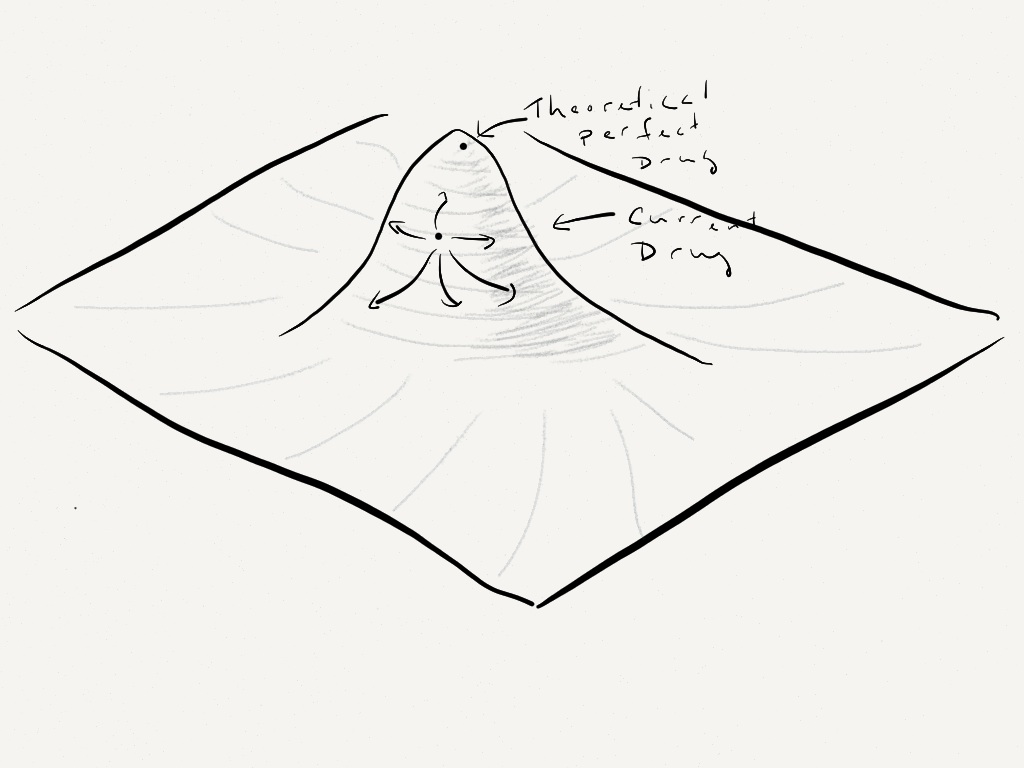
Figure 2

Figure 2: The adaptive landscape for drug development.  Yes I drew this myself.  I would plug the drawing program, except I think they’d probably prefer not to be associated with this image. Continue reading

When business takes a stand

All opinions are my own and do not necessarily reflect those of Novo Nordisk.

Texas!

So much of what happens in the US seems to revolve around Texas.  It’s a huge, rich, diverse state, with influence that stretches far beyond its boundaries.  I mean, you rarely hear about how the politics of Rhode Island affect the nation.  I’m just saying.  Don’t hate me, people of Rhode Island! All eight of  you! Which is still about six more people than read this blog…

That’s why, for example, when Texas experiences outbreaks of whooping cough and measles, it makes the news.  The state is a bellwether for certain cultural and societal trends like the anti-vaccination movement.  And it’s in this context that two recent developments in how businesses are interacting with Texas are fascinating.

Let’s talk textbooks and the death penalty.

Continue reading

Mobile tech and the challenge and opportunity for design

All opinions are my own and do not necessarily reflect those of Novo Nordisk.

Lots of things bother me when I’m driving my car.  But recently I’ve found that the number one thing making me bang my head on the steering wheel is when I’m behind a car at a stoplight, the light changes…and nothing happens. Many times I can see the back of the driver’s head, which is almost always tilted down, and I’m going to go out on a limb and suggest that this is because the person in front of me is texting or surfing the web.

A recent report from the Seattle Times that one in twelve active drivers in Washington State was observed using a cellphone while driving confirms how widespread this problem is. The thing is, the problem is, the opportunity is, this is only one small symptom of how our world is changing and becoming full of distraction. I may be irritated when the person in front of me isn’t paying attention but at the same time I’m continually impressed by the immediacy and mobility of technology.  In some ways, much as I might rant about people who are texting while driving, I also understand why. They do it because it’s easy, simple, and feeds our hardwired desire for rapid positive feedback.

So what can be done? Continue reading

Premature testification is not a laughing matter

All opinions are my own and do not necessarily reflect those of Novo Nordisk.

“These studies, once validated, open an opportunity for creating tests that an expectant mother can take to see if she is producing these autoantibodies. ”

I wrote this statement back in July as part of a post describing the report that maternal autoantibodies to specific neural proteins correlated with the appearance of autism symptoms in the children of those mothers.  Little did I suspect that plans to create a test were already in the works.  Science recently reported (paywall) that researchers behind this study are teaming up with a testing company to develop and market a diagnostic test for maternal autoantibodies.

On the one hand I am much in favor of prognostic tests that will help us anticipate health problems.  I believe in many cases early knowledge and interventions can be helpful, even when there is no “cure.”  One of the hopes for the wave of genomic biomedical research going on now is that it will allow us to better estimate who will and will not come down with specific diseases based on clues in individuals’ DNA.  But on the other hand, it can be problematic when tests are created and released before the underlying biomedical hypothesis has been strongly vetted and supported. Continue reading

Transparency and the invisible hand in hospital and healthcare costs

All opinions are my own and do not necessarily reflect those of Novo Nordisk

One of the things that sometimes seems to get lost when people talk about the power of the market to create efficiency is that a free market requires that information be shared and freely available and understandable by everyone.  When information is withheld by one side or the other of a transaction, or when different customers for a service or product are unable to compare prices, the metaphor of the invisible hand breaks down.

You can see, this, interestingly enough, in sports as it relates to both the trading of players under contract and the signing of free agents.  Since I’m a baseball fan, let me link here to a discussion of research that’s been done looking at Major League Baseball.  The studies looked at players traded or signed by a different team as a free agent and how those players performed in subsequent years versus players whose original team re-signed them.  It turns out that players who switched teams did, indeed, perform more poorly relative to projections than players who stayed.  This suggests that the original teams have proprietary information that allows them to make better decisions about which players to retain.  Thus the market for baseball players isn’t quite free and efficient because of information asymmetry.

And unfortunately, information asymmetry is also rampant in other industries such as healthcare. Continue reading