Genetic counseling at Illumina

All opinions of the interviewer are my own and do not necessarily reflect those of Novo Nordisk.

Illumina is the industry leader in high-throughput sequencing platforms and over the past decade has employed a fascinating mix of innovation, creativity in approach, community engagement and aggressive exploration into different business areas. I recently had the opportunity to interview Erica Ramos, who works as a clinical genomics specialist and certified genetic counselor in the professional services group within Illumina’s CLIA lab, about Illumina and genetic counseling.

Kyle Serikawa:  Can you describe what Illumina is doing in the field of genetic counseling? That is, are you creating a genetic counseling service, or advocating an increase in training of genetic counselors, or creating materials to facilitate counseling?

Erica Ramos: So Illumina has four full time genetic counselors as part of their services group. We don’t provide direct services to patients; Illumina’s model is to provide support to the providers, the physicians. We support what’s being done in the genetics core at Illumina. As for training, we offer opportunities for that. Every year we welcome a second year student in genetic counseling for a 10 week, part time rotation. We’ve done about 5 of those so far. It’s an opportunity for those students to see how genetic counseling skills can be applied to a non-clinical setting. We see the internships as a way to engage these people who will go on to become genetic counselors. Illumina is also a very active in the genetics community, including membership in the American College of Medical Genetics and other organizations.

KS: Given the current landscape of, for example, exome and whole-genome sequencing, it seems like genetic literacy will become an increasingly important skill—both for understanding how genetic variants can be interpreted and also how genetic information will be communicated. How is Illumina thinking about educational needs in genetics?

ER: The genetics community as a whole is concerned about the need for wider understanding of genetics to help inform medical practice. From Illumina’s standpoint, one of the things we can do is to support the internships I’ve described as a way to provide exposure to non-clinical roles for genetic counselors, which broadens the potential market. Also, we’re providing a training option that maybe not all academic programs can support. At the same time, the universities themselves can see the developing need, and through supply and demand we hope to see an increase in the number of genetic counselors being trained.

There is also need for the education and updating of other professions. Physicians, nurse practitioners and others. Illumina has put on the “Understand Your Genome” symposia to work with providers who don’t currently have as deep an understanding as they would like.

KS: How do you see genetic counseling as synergizing with Illumina’s business interests? Continue reading
The Innovator’s Dilemma in biopharma part 2. Where are the markets for disruptive tech?

All opinions are my own and do not necessarily reflect those of Novo Nordisk.

h/t to @Frank_S_David, @scientre, and the LinkedIn Group Big Ideas in Pharma Innovation and R&D Productivity for links and ideas

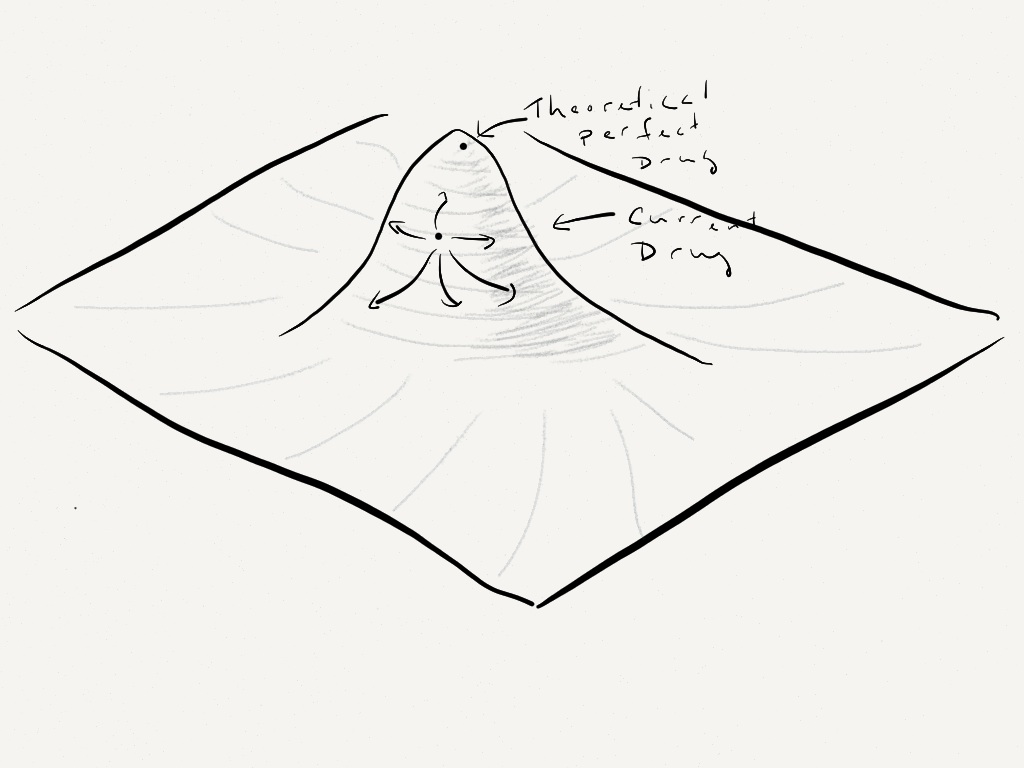
Biopharma may be ripe for disruptive innovation to come in and overturn their markets but that doesn’t mean it will happen. There are constraints beyond those of pure business, including the simple fact that treating diseases is really difficult and we don’t know as much as we would like about how biology really works. I see today’s biopharma market as a victim of its own success. The 80s and 90s saw the creation of truly life-changing, effective drugs like statins, and that has set the bar high enough that I think we’ve passed the inflection point at which approaches like high-throughput screening are becoming less likely to yield a substantial improvement in effectiveness. I’ve used the analogy before of drug development occurring on an adaptive landscape (Figure 2), with every improvement moving up a hill towards the theoretical perfect medicine at the apex. The higher up the hill one gets, the harder it is to move uphill and most efforts move sideways or down, simply because there’s more territory in those directions. This is a constraint that a disruptive innovation would have to overcome in some way.

Figure 2

Figure 2: The adaptive landscape for drug development.  Yes I drew this myself.  I would plug the drawing program, except I think they’d probably prefer not to be associated with this image. Continue reading

The Innovator’s Dilemma in biopharma part 1. Framing the industry’s position

All opinions are my own and do not necessarily reflect those of Novo Nordisk

h/t to @Frank_S_David, @scientre, and the LinkedIn Group Big Ideas in Pharma Innovation and R&D Productivity for links and ideas

Joe Nocera’s recent column in the New York Times provided a nice dissection of how Blackberry tumbled from the position it once held at the top of the handheld phone/PDA business market.  In a nutshell it encapsulates how Blackberry fell victim to the Innovator’s Dilemma, the paradigm put forward by Clay Christensen about how and why established companies within an industry often fall victim to disruptive technologies.  This happened even though they were aware of the danger and made efforts to circumvent the dilemma.  In the case of Blackberry, one aspect of their fall was a lack of appreciation for the technology creeping up behind: the iPhone and other mobile devices using touchscreens.  For Blackberry one of their advantages and selling points was a physical keyboard which allowed rapid typing and emailing by business customers.  They couldn’t see why anyone would want something less effective for emails and messaging.

In addition, Blackberry felt both secure in and beholden to their customer base, the businesspeople who used Blackberries strictly as tools for work.  Blackberry (Research in Motion at the time) seemed both unable to conceive of the possibility of other markets and, frankly, had no incentive to reach into those markets until it was too late.  By then other phones and operating systems had grown and matured to the point of essentially overtaking the market of smartphone users, of which businesspeople make up just a small fraction.  Too little, too late, and now Blackberry has been trying to sell itself, although recent reports suggest that strategy is also failing.

From Blackberry to biopharma

In this post I’d like to explore the concept of the Innovator’s Dilemma as it might apply to the biopharmaceuticals industry.  Continue reading

What do labrador retrievers and NFL wide receivers have in common?

All opinions are my own and do not necessarily reflect those of Novo Nordisk.

A.  They’re both being studied via mobile tech to create their ethograms.

What’s an ethogram?  I had no idea until I saw this PLOSone paper on using inertial sensors such as accelerometers and gyroscopes to measure the movements and behaviors of dogs, so as to create an ethogram, or collection of behaviors and actions, characteristic of labrador retrievers and Belgian Malinois.  For scientists studying the behavior and action patterns of different species, building an ethogram is essential to studies of animal behavior.  Without a standardized, objective catalog of behaviors, it can be easy for the perspectives of the observer to get in the way.  And it can make comparisons of data among different researchers (or coaches, as we’ll discuss in a bit) difficult.

And just as I was mulling over how that study shows the power of technology for behavioral research, the latest issue of Sports Illustrated came in the mail and I read a short, fascinating article by Tim Newcomb about how eight NFL teams have signed up with the company Catapult to integrate small GPS sensors into practice and game uniforms. This data allows a more accurate, granular and comprehensive view of how different receivers, for example, play the game.  Basically, building the receiver ethogram (using the term rather loosely). Sadly, this article is currently only in the print issue and not online that I can find.  But it’s at newsstands now.  You can go pick one up.  I’ll wait.

So let me delve into each of these articles a little more.

Continue reading

Mobile tech and the challenge and opportunity for design

All opinions are my own and do not necessarily reflect those of Novo Nordisk.

Lots of things bother me when I’m driving my car.  But recently I’ve found that the number one thing making me bang my head on the steering wheel is when I’m behind a car at a stoplight, the light changes…and nothing happens. Many times I can see the back of the driver’s head, which is almost always tilted down, and I’m going to go out on a limb and suggest that this is because the person in front of me is texting or surfing the web.

A recent report from the Seattle Times that one in twelve active drivers in Washington State was observed using a cellphone while driving confirms how widespread this problem is. The thing is, the problem is, the opportunity is, this is only one small symptom of how our world is changing and becoming full of distraction. I may be irritated when the person in front of me isn’t paying attention but at the same time I’m continually impressed by the immediacy and mobility of technology.  In some ways, much as I might rant about people who are texting while driving, I also understand why. They do it because it’s easy, simple, and feeds our hardwired desire for rapid positive feedback.

So what can be done? Continue reading